
Replacement Levy - FAQ
Frequently Asked Questions (FAQ)
Below are answers to frequently asked questions about the proposed CVSD Replacement Education Programs & Operations (EP&O) Levy, which will appear on the November 3, 2026 ballot.
Have another question? Fill out our question form or email [email protected].
What does an EP&O Levy provide?
An EP&O levy provides local funding that bridges the gap between what the state and federal funding provided to districts and the actual costs of operating a school district.
Local levy dollars support classroom staffing and student services, including teachers, nurses, counselors, social workers, paraeducators, academic intervention, curriculum, classroom materials and other student supports. The levy also helps fund electives, career and technical education, arts, music, athletics, performing arts, clubs and other extracurricular opportunities.
CVSD’s local levy also helps cover gaps in funding for special education, transportation, nutrition services, school safety, utilities, insurance, maintenance and daily school operations.
For example, local levy funding supports approximately 300 additional teaching and support staff positions beyond what the state funding model provides.
The levy also supports all district athletics, performing arts and extracurricular activities. Approximately $5.8 million annually in local levy funding supports these opportunities—100% paid by the levy.
Local levy funding currently represents 16.2% of CVSD’s annual operating revenue.
CVSD has had a voter-approved local EP&O Levy for more than 50 years.
How much is the proposed EP&O Replacement Levy?
The proposed replacement levy has a maximum estimated tax rate of $2.50 per $1,000 of assessed property value.
The district is proposing the same maximum levy rate as the current levy: no more than $2.50 per $1,000 of assessed value.
Proposed maximum levy amounts & estimated property tax rate:
|
Collection Year |
Est. Maximum Rate |
Est. Maximum Levy Amount (District-wide to be approved by voters) |
Est. Annual Levy Amount (For a median assessed home value of $418,000) |
|---|---|---|---|
|
2028 |
$2.50/thousand |
$48,900,000 |
$1,045 ($87/month) |
|
2029 |
$2.50/thousand |
$50,550,000 |
$1,045 ($87/month) |
|
2030 |
$2.50/thousand |
$52,400,000 |
$1,045 ($87/month) |
Amounts increase based on expected growth and to reflect the district’s projected operating budget, including anticipated inflation and the cost of operating schools.
The rate is an estimate and may be lower, depending on assessed property values. The district cannot collect more than the voter-approved levy amount or exceed the authorized levy rate.
What would the EP&O levy cost on a $418,000 median home value assessed property?
At the maximum estimated rate of $2.50 per $1,000, the calculation would be:
$418,000 ÷ $1,000 × $2.50 = $1,045 per year
That equals approximately $87.08 per month.
This is an example for comparison purposes. Actual taxes depend on the assessed value of an individual property and the final levy rate. Levy estimator at: www.cvsd.org/levycalculator
Is this a new tax?
It is a replacement levy.
If approved, it would replace the existing voter-approved EP&O levy when that levy expires in 2027. The current levy was approved by voters in 2024 and is currently the same rate as the proposed rate.
The proposed replacement would begin collections in 2028 and continue through 2030.
The estimated levy tax rate of $2.50 maximum per $1,000 of assessed valuation is the same as the current levy rate.
What happens if property values increase?
The levy is approved as a total collection amount, subject to levy limits. The district cannot collect more than a maximum of $2.50 per thousand of assessed value. If property values go up, the tax rate is actually adjusted downward.
If the total assessed value of property throughout the district increases, the tax rate needed to collect the voter-approved amount may decrease. An increase in property values does not allow the district to collect more than the authorized levy amount.
Individual property taxes may still change, depending on how the assessed value of a particular property changes relative to other properties within the district.


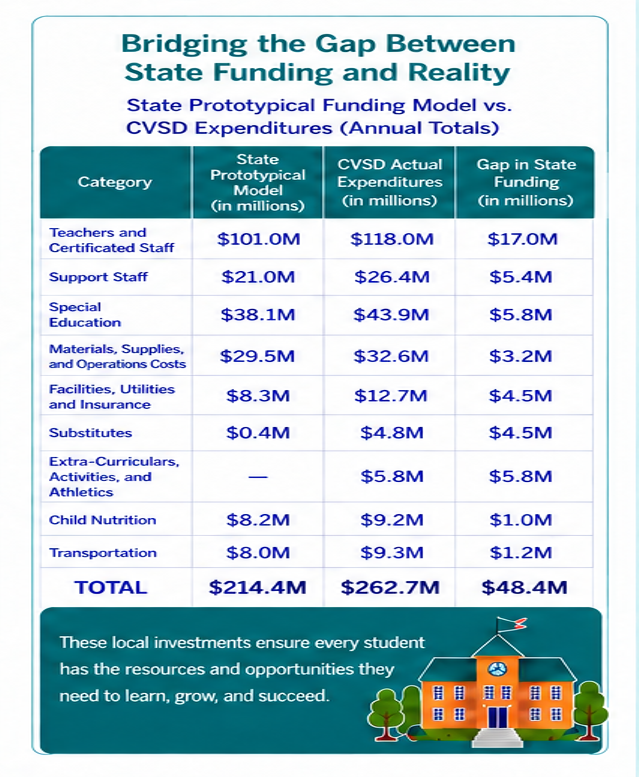
How does the state funding model compare with CVSD's actual costs?
Washington's prototypical school funding model provides a formula for state funding, but it does not cover the full cost of CVSD's current staffing, programs and operations.
For major operating categories identified in the district's 2026–2027 budget, the state model provides approximately $214.4 million, compared with approximately $262.7 million in actual district costs—a difference of approximately $48.4 million. Figures are annual estimates and have been rounded for presentation.
Local levy dollars help address portions of those funding differences.
What are some examples of costs supported by local levy funding?
Local levy funding helps support:
- Teachers and certificated staff: Approximately $17 million (14%) of the difference between state funding and actual district costs. Local funding supports additional classroom teachers, nurses and certificated student-support positions.
- Support staff: Approximately $5.4 million (20%), including paraeducators, school assistants, custodians, office staff, technology staff and facilities employees.
- Special education: Approximately $5.8 million (13%) beyond state and federal funding for specialized instruction, paraeducators, related services, materials and individualized supports.
- Materials and operating costs: Approximately $3.2 million (10%) for curriculum, classroom materials, instructional resources, software, contracted services and other operating expenses.
- Facilities, utilities and insurance: Approximately $4.5 million (35%) beyond state funding for maintaining, heating, powering and insuring schools.
- Substitutes: Approximately $4.5 million (95%) beyond state funding to provide classroom and operational coverage when employees are absent.
- Activities and athletics: Approximately $5.8 million annually (100%) for athletics, performing arts, clubs, student leadership and other extracurricular activities.
- Child nutrition: Approximately $1 million annually (11%) to help cover food, staffing, equipment and operating costs.
- Transportation: Approximately $1.2 million annually (13%) beyond state funding for routes, staffing, fuel, maintenance and specialized transportation.
What are my current taxes and distribution?
Because each property's assessed value is different, this is the best way to review taxes for a specific property.
The district is proposing the same maximum levy rate as the current levy: no more than $2.50 per $1,000 of assessed value.
How can I estimate what I would pay?
 Use CVSD's Levy Assessment Calculator to see your property's assessed value and estimate the amount associated with the proposed levy.
Formula:
Assessed property value ÷ $1,000 × estimated levy rate
For example:
$418,000 ÷ $1,000 × $2.50 = $1,045 per year
Does the levy affect senior citizens or people with disabilities?
Eligibility depends on factors established by state law, including age or disability status, ownership and occupancy requirements, and household income.
Contact the Spokane County Assessor's office at (509) 477-3698 or visit its property-tax exemption information for current eligibility requirements. Spokane County currently administers senior and disabled property-tax exemptions.
Do apartments, businesses and other properties pay the levy?
The property owner is responsible for the property tax, based on the property's assessed value and tax rates.
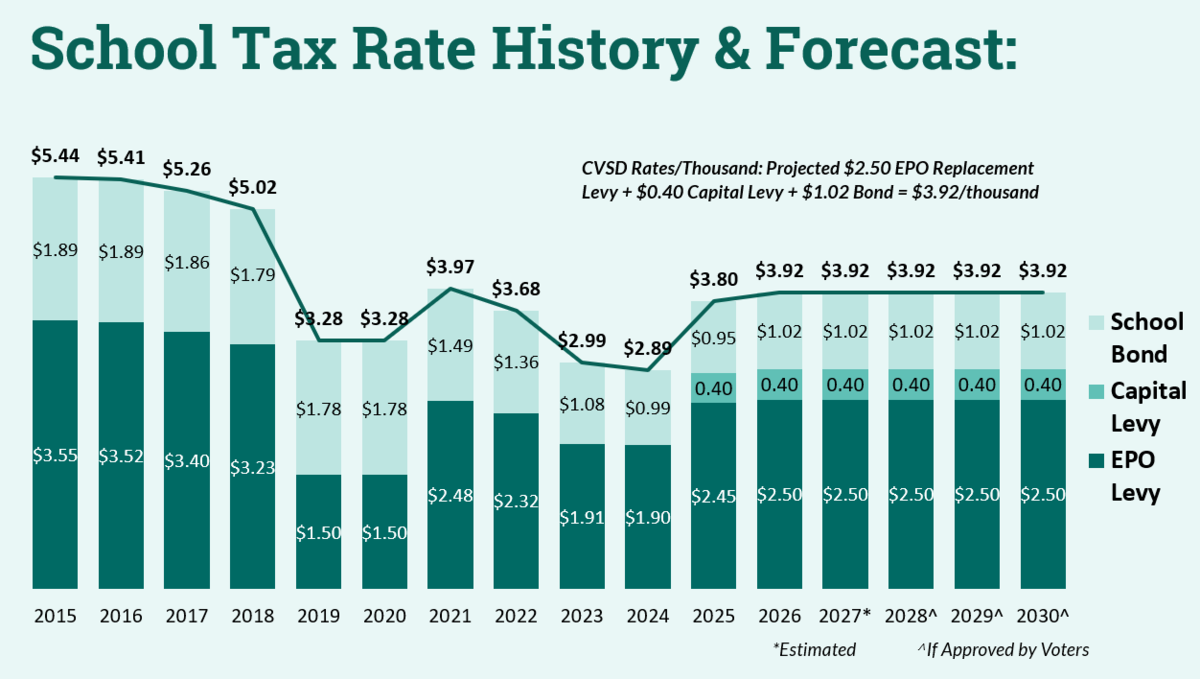
How much will the EP&O Replacement Levy cost together with the Capital Improvements Levy and the Bonds?
Estimated Tax on Median Home Value
|
Est. CVSD Levy Rate (per thousand of assessed value) |
Est. Levy Tax (for Median Assessed Home Value of $418,000) |
Est. Monthly Tax |
|
|---|---|---|---|
|
Est. EP&O Rate |
$2.50 |
$1,045 |
$ 87.08 |
|
Est. Total CVSD Rate |
$3.92 ($2.50 EP&O, $1.02 Bond, $0.40 Capital Levy) |
$1,638 |
$136.55 |
What is the difference between an EP&O Levy, a Capital Levy and a Bond?
EP&O Levies - Programs and Operations
The EP&O levy supports student learning, supports, staffing, services, extracurricular opportunities and day-to-day school operations and programs that are not fully funded by the state. CVSD has run this levy replacement on a three-year cycle, providing a well-rounded, comprehensive education for our students for more than 50 years.
Capital Improvement Levy - Maintain and Improve
Bonds - Build and Modernize
Bonds provide long-term financing for major construction projects such as building, renovating or modernizing schools. Bond proceeds cannot be used to pay for regular educational programs or day-to-day operating expenses. Bonds, similar to a home mortgage, represent a debt that is generally amortized over a much longer period of time (15, 20, or even 25 years). All 2015 and 2018 construction bond projects were completed on time and under budget—including ten more projects beyond what was promised.
How much is the tax rate for the 2015 and 2018 Construction Bonds?
How does CVSD report how local tax dollars are being used?
CVSD has a history of reporting updates to our community. Accountability is an important value for our district.
CVSD publishes budget, financial and project information for the public and provides regular financial reports to the School Board. The district's current budget page includes its 2026-2027 adopted budget, budget accountability reports, budget status reports and other financial documents.
The district also publishes information about capital improvement projects and previously approved construction bond projects, including project status and expenditures.
The majority of projects from the capital improvement levy have already been completed—five years earlier than promised to our Central Valley community. This includes making safer school entrances at ten schools in the last two years.
All 2015 construction bond and 2018 construction bond projects were completed on time and either within or under budget. By leveraging every possible dollar, the district and CVSD School Board completed ten additional construction projects than what was originally promised to the Central Valley community—with no additional taxpayer dollars. The 2015 and 2018 bond web pages linked above indicate projects that had additional dollars allocated; i.e. Riverbend Elementary and its additional expansion, North Pines Middle School, phase three of Spokane Valley Tech, Central Valley Virtual Learning, Horizon Middle School tennis courts, the synthetic turf at CVHS / RHS / UHS, and HVAC at CVHS.
Questions about levy funding or district finances may be sent by filling out our question form or emailing [email protected].
